
(If this is your first time on this blog, I ask you to read my About page first! Thanks!)
When I was younger, I read the Great Illustrated Classics version of Jack London’s White Fang. While I don’t remember what it was about other than something to do with a wolfdog, I do remember enjoying it along with The Call of the Wild.
So when I discovered that Disney had made a film adaptation of the novel, I figured that would be my reintroduction to the story. Did I like the film or would this turn out to be just another animal-centric live-action Disney film? Read on to find out!
And remember, SPOILERS AHEAD!
Directed by Randal Kleiser, White Fang takes place during the Klondike Gold Rush and begins with young Jack Conroy, played by Ethan Hawke, arriving in Alaska to find his dead father’s claim. There he meets two mushers who knew his father. One is Alex Larson, played by Klaus Maria Brandauer, and the other is known as Skunker, played by Seymour Cassel. Alex is the leader and more gruff while Skunker is friendlier and tries to ease tensions between Alex and Jack when their egos clash at times.
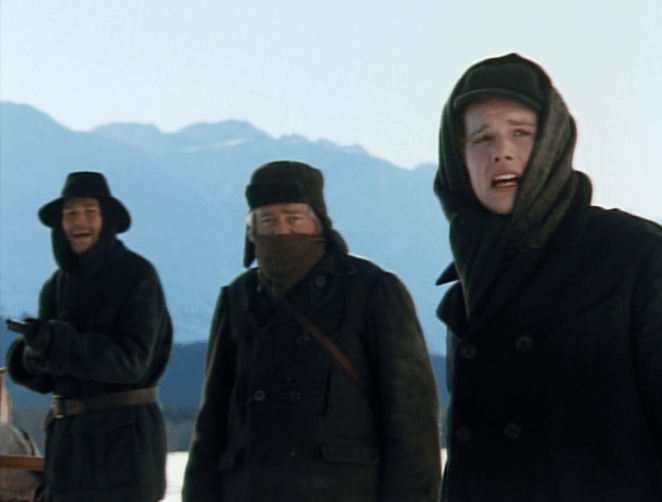
Jack convinces them to take him to his father’s claim via dogsled. Along the way, they come across obstacles such as thin ice and wolves; the latter sadly results in Skunker’s death. Jack and Alex are saddened by this and Jack starts to realize some of the realities of life.
The two continue along their journey and come upon a Native American settlement whose chief owns a wolfdog named White Fang. White Fang’s mother was killed when he was a pup. The chief found him and raised him as his own. While White Fang has been raised to be unfriendly, there is an instant connection between him and Jack. This is evident in a later scene wherein White Fang saves Jack from a grizzly bear.
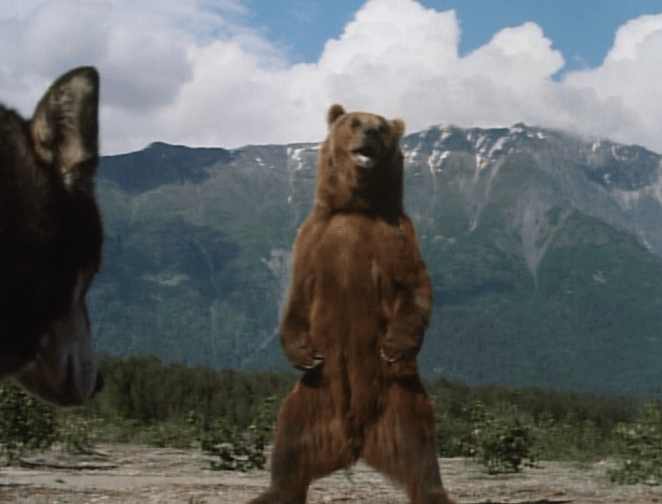
Jack and Alex eventually make it to Jack’s father’s claim and accompanying cabin in the wilderness. They begin their search for gold. One day when he ventures into town, Jack discovers that a bully dogfighter named Beauty Smith, played by James Remar, now owns White Fang. Beauty uses White Fang in illegal dogfights all while abusing him. Jack rescues White Fang, much to Beauty’s dismay, and takes him back to the cabin.
Jack begins to train White Fang to be friendlier and docile resulting in a growing bond between the two. One day, Alex and Jack find gold and Jack takes the gold into town to verify its authenticity. It turns out to be genuine and papers are signed naming him and Alex the rightful owners of the gold.
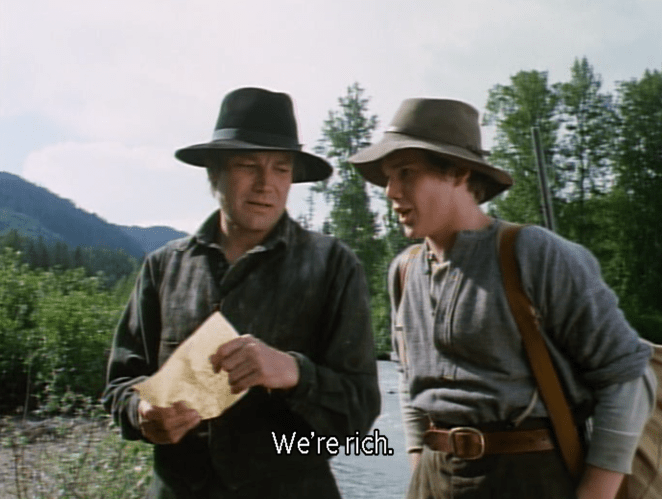
Beauty and his gang get wind of this and stage an attack on the cabin, but are overcome, mostly due to White Fang, and are taken back to town to the authorities.
Alex plans to use his share of the gold to open a hotel in San Francisco with his love, Belinda, played by Susan Hogan. He names Jack a partner and invites him to go with them. Jack agrees and sadly bids farewell to White Fang whom he releases back into the wild.
However, he changes his mind and decides to stay in Alaska and continue living in the cabin. Alex tells him that the hotel partnership is still open should he ever decide he wants it. The film ends with Jack and White Fang being reunited.
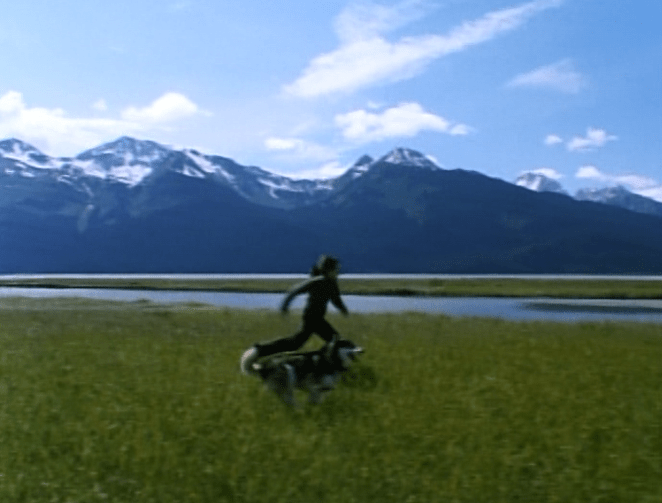
And that was White Fang! I can’t say how accurate it is to the novel since I can’t remember it much, but I did find a lot of the movie to be boring. There are many slow scenes amidst the Alaskan wilderness. And surprisingly enough, the film doesn’t really make White Fang the star! It doesn’t even really make Jack the star! You could probably argue that Alaska itself is the star? Again, this could be how it’s portrayed in the novel, but I couldn’t say.
I also didn’t find anybody’s acting to be particularly powerful. Maybe Ethan Hawke’s was the most believable? Or Seymour Cassel’s? Well actually, the best performances were by White Fang and the animals in the film. You could tell that they were trained differently than other animals in older Disney films.
Another thing I enjoyed was this wistful melody that would play at times during the film. Besides that though, I wasn’t impressed with this film. And again (for the third time), that could just be because that’s how the novel is.
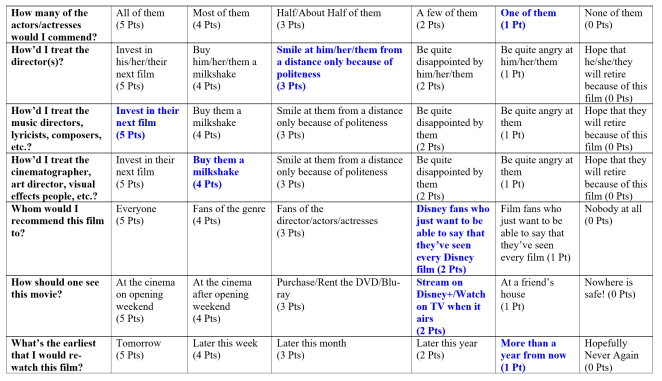
So, my final score for this film is 18/35 = 51.43% (F) !
The next review will be posted on October 8, 2024.

 My Live Action Disney Project